By EHDI Initiative
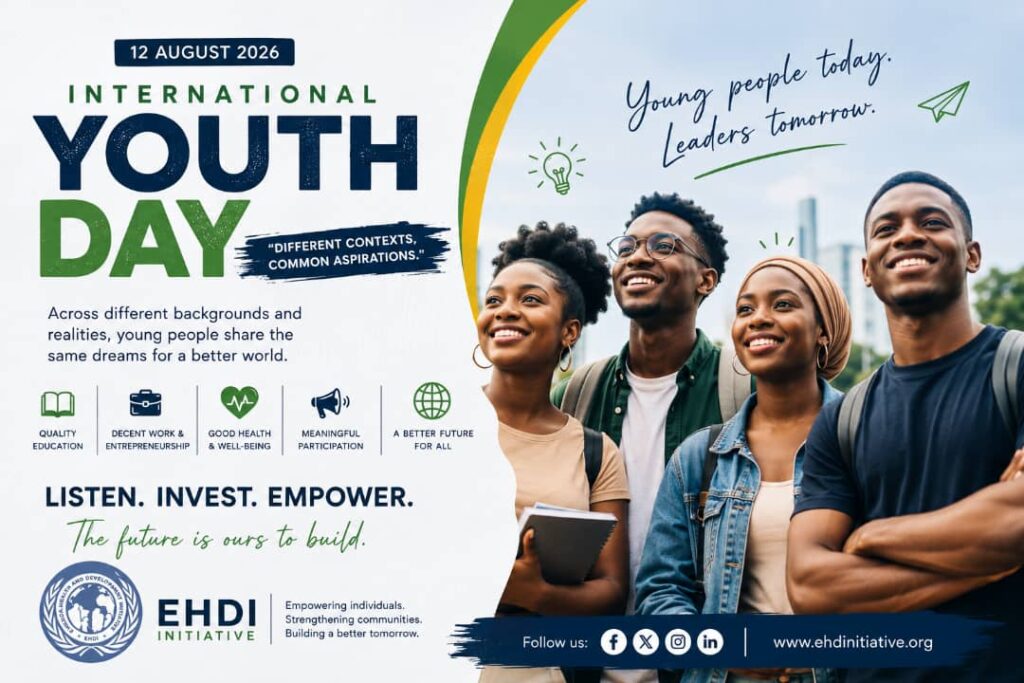
International Youth Day 2026 | 12 August 2026
Young people may grow up in different communities, attend different schools, speak different languages, and face very different realities. Yet beneath these differences are aspirations that connect them: the desire to learn, to work, to be heard, to live with dignity, and to build a better future.
This is the heart of International Youth Day 2026, observed on 12 August under the theme “Different Contexts, Common Aspirations.” The theme recognizes that although young people experience life in different circumstances, many of their hopes and challenges are remarkably similar. The United Nations highlights aspirations including quality education, decent work, good health and well-being, meaningful participation in decisions, and opportunities to build better futures.
For Nigeria, this theme presents an important opportunity to look beyond celebrating young people for one day and ask a more fundamental question:
What are we doing to create the opportunities young people need to thrive?
Beyond Celebration: Listening to Young People
International Youth Day should not only be about speeches, social media posts, or congratulatory messages.
It should be a moment to listen.
Across Nigeria, young people are navigating an increasingly complex world. Many are pursuing education while worrying about the cost of learning. Others are searching for employment in an economy that demands experience before giving them the opportunity to gain it. Some are building businesses with limited resources, while others are learning digital skills in the hope of creating opportunities beyond their immediate communities.
Young Nigerians are not lacking ambition.
What is often missing is access.
Access to quality education.
Access to skills.
Access to healthcare and well-being support.
Access to technology.
Access to mentorship and networks.
Access to decent employment.
Access to finance and opportunities.
And, importantly, access to spaces where their voices can influence decisions.
The challenge, therefore, is not simply to tell young people to “work harder.” It is to build systems and communities in which their hard work can translate into meaningful opportunity.
The Opportunity Gap
Talent is everywhere.
Opportunity is not.
A young person with an innovative idea may lack the resources to develop it. A graduate may have academic qualifications but lack practical experience. A talented young person in a rural community may have limited access to the technology, mentorship or networks available to someone in a major city.
This difference creates what can be described as an opportunity gap.
Closing that gap requires more than individual effort. It requires collaboration among governments, civil society organizations, educational institutions, businesses, communities, families and young people themselves.
Development must therefore move beyond asking young people what they can contribute and begin asking what society can do to remove the barriers standing in their way.
Education Must Connect to Opportunity
Education remains one of the strongest pathways to empowerment, but education must prepare young people for the realities they will encounter beyond the classroom.
The world of work is changing rapidly. Technology, artificial intelligence, digital platforms and new forms of entrepreneurship are transforming how people learn, work and create value.
Young people need opportunities to develop not only academic knowledge but also practical and transferable skills such as:
- Critical thinking
- Problem-solving
- Communication
- Digital literacy
- Entrepreneurship
- Creativity
- Financial literacy
- Collaboration
- Adaptability
The United Nations has similarly emphasized the importance of skills such as critical thinking, problem-solving and digital literacy as young people prepare for the future.
For organizations working in youth development, this presents a clear responsibility: skills development must be connected to real pathways to opportunity.
Training should not end with a certificate. It should open a door.
Young People Are Not Just Beneficiaries
One of the most important shifts we can make in youth development is changing how we see young people.
Young people are not simply beneficiaries of development programmes.
They are partners, innovators, leaders and problem-solvers.
Across the world, young people are creating businesses, developing digital solutions, leading community initiatives, advocating for social change and contributing to environmental action. The United Nations recognizes that young people are already leading initiatives and creating innovative responses to some of the world’s most pressing challenges.
Nigeria is no different.
From technology and creative industries to agriculture, education, healthcare, entrepreneurship and community development, young Nigerians continue to demonstrate creativity and resilience.
But potential should not have to survive on resilience alone.
Young people deserve systems that recognize their potential and give them the tools, resources and platforms to turn ideas into impact.
Giving Young People a Seat at the Table
Young people are directly affected by decisions about education, employment, healthcare, technology, climate, security and community development.
Therefore, their voices should be part of the conversations shaping these areas.
Meaningful youth participation goes beyond inviting young people to events. It means creating genuine opportunities for them to contribute to planning, implementation, monitoring and decision-making.
This is particularly important at the community level, where young people often understand local challenges in ways that institutions may not.
The United Nations has repeatedly emphasized that youth engagement should be systematic, sustained and connected to real policy outcomes.
When young people are treated as partners rather than spectators, development becomes more responsive, innovative and inclusive.
Well-Being Must Be Part of the Conversation
We cannot talk about youth development without talking about youth well-being.
Young people are navigating academic pressure, unemployment, economic uncertainty, social expectations, insecurity and a rapidly changing digital environment.
The United Nations’ work on youth well-being has highlighted how issues such as unemployment, poverty, insecurity and climate anxiety can affect young people’s well-being.
Creating opportunities for young people therefore means creating environments where they can pursue those opportunities while also having access to appropriate health, psychosocial and community support.
A successful young person should not simply be measured by income or professional achievement.
Well-being matters. Dignity matters. Safety matters. Belonging matters.
From Youth Potential to Youth Power
There is a tendency to describe young people as “the leaders of tomorrow.”
But young people are already contributing today.
They are volunteering today.
They are creating today.
They are innovating today.
They are organizing today.
They are solving problems today.
They are leading communities today.
The question should therefore not only be, “How do we prepare young people for tomorrow?”
It should also be:
“How do we create opportunities for young people to contribute meaningfully today?”
This shift matters because development cannot afford to postpone the contributions of an entire generation.
What Can We Do?
Creating a better future for young people is a shared responsibility.
Governments can:
Develop policies that expand access to quality education, decent work, entrepreneurship, healthcare and digital opportunities while creating meaningful mechanisms for youth participation.
Businesses can:
Invest in internships, apprenticeships, mentorship, skills development and pathways that help young people transition from learning to employment or entrepreneurship.
Civil society organizations can:
Create inclusive programmes that respond to real community needs, amplify youth voices and connect young people with knowledge, skills, networks and opportunities.
Educational institutions can:
Strengthen practical learning and equip students with skills relevant to a changing economy.
Communities can:
Create safe spaces where young people can learn, collaborate, innovate and participate in solving local problems.
Young people can:
Continue learning, building networks, supporting one another, participating in their communities and using their creativity to develop solutions to the challenges around them.
A Shared Future Requires Shared Action
“Different Contexts, Common Aspirations” is more than a theme.
It is a reminder that young people may have different starting points, but many share the same fundamental hopes: to be respected, to have opportunities, to live healthy and meaningful lives, to contribute to society and to have a voice in the future they will inherit.
For Nigeria, investing in these aspirations is not simply a youth-development issue.
It is a development imperative.
A country that invests in its young people is investing in its workforce, communities, innovation, leadership and future.
At EHDI Initiative, we believe that young people should not be defined by the challenges they face, but supported to become active participants in creating solutions to those challenges.
International Youth Day reminds us to celebrate young people.
But celebration should be followed by action.
Let us listen to young people.
Let us invest in young people.
Let us create opportunities for young people.
Let us work with young people.
Because different contexts may shape their experiences, but their aspirations are shared.
And when those aspirations are matched with opportunity, support and meaningful participation, young people do not simply prepare for the future.
They help build it.
About EHDI Initiative
EHDI Initiative is committed to supporting positive development and creating opportunities that enable individuals and communities to thrive. Through advocacy, community engagement, education and strategic initiatives, EHDI seeks to contribute to a more inclusive and empowered society where people have the knowledge, opportunities and support needed to reach their potential.
On International Youth Day 2026, EHDI Initiative explores the aspirations, challenges and opportunities facing Nigerian youth and why meaningful youth inclusion matters.