By EHDI Initiative
14 August 2026
Nigeria is filled with young people who are talented, ambitious and determined to succeed.
There is the young graduate with an innovative business idea.
The creative who can turn an ordinary concept into something remarkable.
The student teaching themselves technology from a smartphone.
The young farmer experimenting with new approaches.
The aspiring entrepreneur building a business from almost nothing.
The talent is there.
The ambition is there.
The ideas are there.
But there is a question we must ask:
What happens when talent meets a lack of opportunity?
Talent can open a door, but opportunity determines whether there is a door to open.
This is the reality behind Nigeria’s opportunity gap—the difference between what young people are capable of achieving and the opportunities, resources and systems available to help them achieve it.
Talent Is Everywhere. Opportunity Is Not.
One of the greatest misconceptions about success is that talent alone is enough.
We often tell young people to work hard, stay focused, acquire skills and believe in themselves. These messages are important, but they are incomplete.
A talented young person may work extremely hard and still struggle if they cannot access quality education, reliable technology, mentorship, professional networks, finance or decent employment opportunities.
Consider two young people with the same potential.
One has access to a laptop, stable internet, professional mentors, training programmes and a network of people who can recommend them for opportunities.
The other has the same talent but limited internet access, little professional guidance and no meaningful network.
Their potential may be similar.
Their opportunities are not.
This is where the opportunity gap becomes visible.
The Hidden Cost of Unequal Access
When opportunities are limited, talent can remain invisible.
A brilliant young person may never develop their idea because they cannot afford the tools required.
A skilled graduate may remain unemployed because they cannot get the experience employers demand.
An aspiring entrepreneur may abandon a promising business because access to capital is out of reach.
A young person in a rural or underserved community may never discover opportunities available to their peers in larger cities.
The result is not simply an individual loss.
Society loses too.
Every unrealized idea represents innovation that never happened. Every young person who could not access an opportunity represents potential that was never fully developed.
Closing the opportunity gap is therefore not charity.
It is an investment in human capital and community development.
Education Is Important, But Is It Enough?
Education remains one of the most powerful tools for social and economic advancement.
But obtaining a certificate does not automatically guarantee economic opportunity.
Young people increasingly need a combination of knowledge, practical skills, experience, adaptability and access to networks.
The transition from education to employment can be difficult when young people are expected to have experience before they have been given an opportunity to gain experience.
This is why internships, apprenticeships, mentorship programmes, career guidance and practical training matter.
A certificate can demonstrate what someone has studied.
An opportunity allows them to demonstrate what they can do.
Digital Access Can Change the Equation
Technology has created new possibilities for young Nigerians.
A young person with an internet connection can learn from global educators, develop digital skills, build a portfolio, reach customers, collaborate across borders and access opportunities that were once geographically impossible.
But digital opportunity is not equally accessible.
The cost of devices, internet connectivity, electricity and quality digital education can still create barriers.
As technology and artificial intelligence continue to transform education and employment, digital inclusion must become an important part of youth development.
We cannot tell young people to prepare for the future while leaving some of them without access to the tools that are shaping that future.
Mentorship Can Open Doors
Sometimes, the missing resource is not money.
It is information.
A young person may have the ability to succeed but may not know where to begin, which opportunity to pursue, how to present their work or who to approach.
This is where mentorship becomes powerful.
A mentor can provide guidance, perspective, encouragement and access to networks.
One meaningful introduction can lead to an internship.
One conversation can improve a business idea.
One recommendation can create an opportunity.
One person believing in a young person’s potential can change the direction of their journey.
Access to the right people can be just as important as access to the right tools.
What Can We Do About the Opportunity Gap?
Closing the opportunity gap requires collective action.
Governments
Government has a critical role in creating an environment where young people can access quality education, decent work, entrepreneurship support, digital infrastructure and meaningful participation in development.
Businesses
Businesses can create pathways into employment through internships, apprenticeships, graduate programmes, mentorship and skills development.
Young people should not only be viewed as consumers or future employees. They are also potential innovators, entrepreneurs and partners.
Civil Society Organizations
Organizations working in communities can help identify underserved young people and connect them with skills, information, mentorship and opportunities.
They can also create platforms where young people are heard and involved in designing solutions to problems that affect them.
Communities
Communities can create safe spaces for young people to learn, collaborate, volunteer and develop initiatives that respond to local needs.
Young People
Young people also have a role to play.
Keep learning.
Build practical skills.
Seek mentorship.
Create networks.
Volunteer.
Build a portfolio of your work.
Look for opportunities—but also create them where possible.
Your circumstances may influence your starting point, but they do not have to define your destination.
From Potential to Possibility
The conversation about Nigerian youth must move beyond telling young people to “work hard.”
We must also ask whether the systems around them are creating pathways for that hard work to produce results.
A young person should not have to be exceptionally lucky to access an opportunity.
They should be able to find pathways through education, skills development, mentorship, employment, entrepreneurship and community participation.
Talent is the potential.
Skills develop the potential.
Opportunity activates the potential.
Support sustains the potential.
Impact is what happens when all four come together.
EHDI’s Perspective
At EHDI Initiative, we believe that empowering people requires more than telling them what they are capable of becoming.
It requires helping create the conditions in which that potential can be realized.
Youth development should therefore focus not only on identifying talent but also on building pathways that connect talent to opportunity.
That means supporting education and skills development, encouraging meaningful participation, strengthening communities and creating spaces where young people can contribute their ideas and solutions.
Because Nigeria does not have a shortage of talented young people.
The challenge is ensuring that talent is not wasted because opportunity was out of reach.
The Opportunity We Cannot Afford to Lose
Every generation inherits challenges.
But every generation also carries the potential to solve them.
Nigeria’s young people are not simply waiting to be empowered. Many are already creating, innovating, volunteering, building businesses, developing solutions and serving their communities.
What they need is an ecosystem that helps their efforts go further.
So perhaps the question we should be asking is not:
“Are Nigerian young people talented enough?”
The evidence tells us they are.
The better question is:
“Are we creating enough opportunities for their talent to become impact?”
That is the opportunity gap.
And closing it is a responsibility we all share.
At EHDI Initiative, We Believe:
Talent should be discovered.
Skills should be developed.
Opportunities should be accessible.
Voices should be heard.
And potential should have a pathway to impact.
The future of Nigeria will not be determined only by how talented its young people are.
It will also be determined by what we choose to do with that talent today.
EHDI Initiative is committed to contributing to inclusive development by supporting initiatives that empower individuals, strengthen communities and create pathways for people to reach their potential.
Through education, advocacy, community engagement and development-focused initiatives, EHDI seeks to contribute to a society where opportunity is not limited by circumstance and where individuals are empowered to become active contributors to their communities.
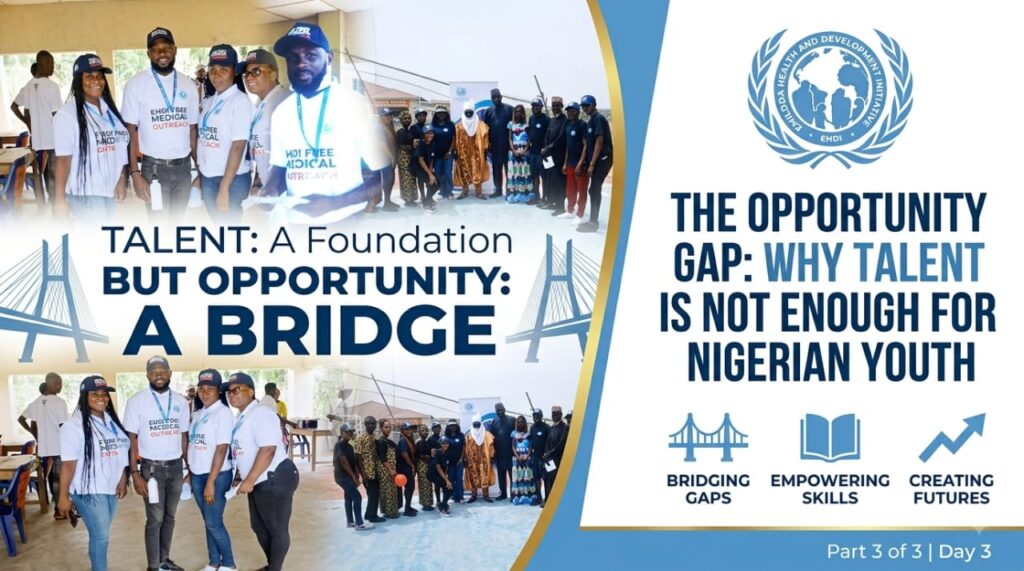
Because potential should never be the end of the story. Opportunity should be the bridge to impact.
TheOpportunityGap #YouthDevelopment #YouthEmpowerment #NigerianYouth #YouthOpportunities #InvestInYouth #SkillsDevelopment #YouthEmployment #DigitalInclusion #CommunityDevelopment #YouthForChange #EHDIInitiative